

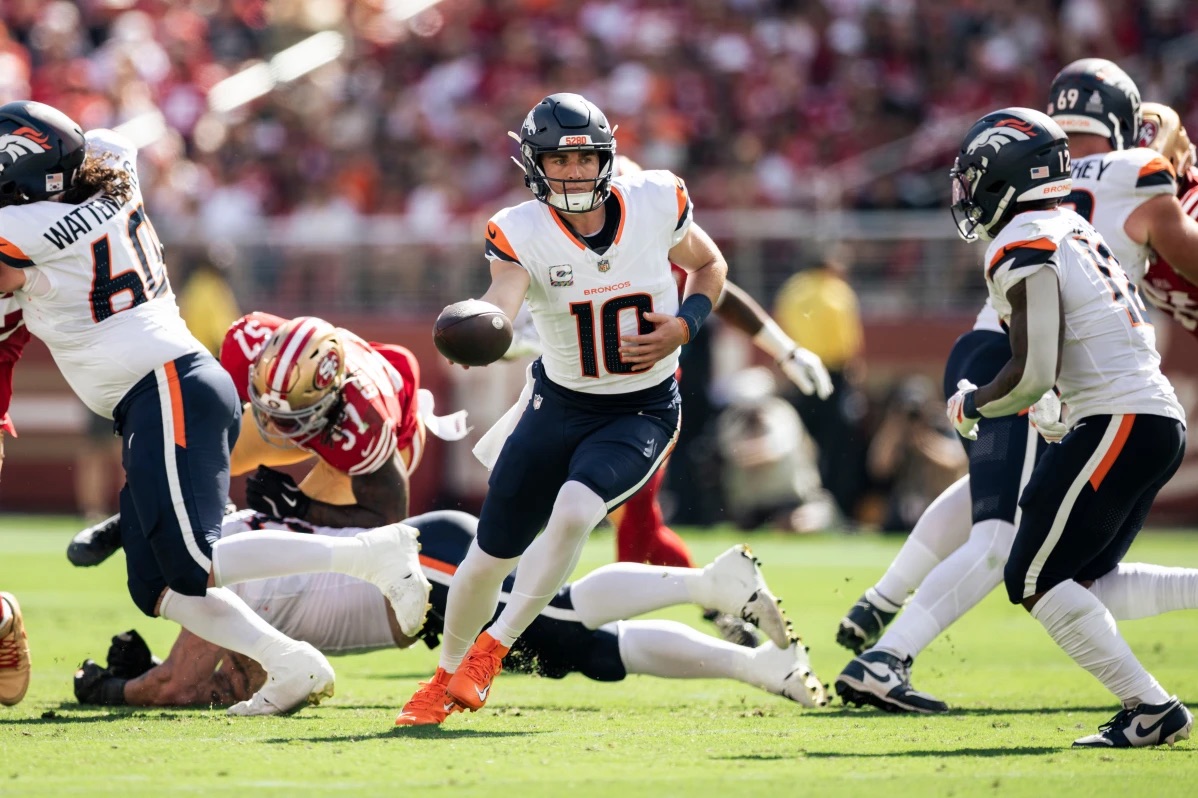
The Denver Broncos went toe-to-toe with one of the NFL’s top teams for most of Sunday afternoon, but the slim margin Sean Payton referenced after the game ultimately decided it.
San Francisco made the handful of game-changing plays Denver could not, pulling away in the second half for a 24-14 win over the Broncos.
“This is what I told the team, obviously it’s not the result that we wanted,” Payton said. “They’re a good football team. We knew it was going to be a tight game, and I thought we played hard, and the margins become very slim. There are a couple of plays that can go either direction. Those guys made them, and we didn’t.”
That was essentially the story of Denver’s afternoon.
The Broncos’ defense gave the offense opportunities early, keeping San Francisco from taking control of the game while Denver struggled to consistently finish drives.
Even when the Broncos converted on third down, quarterback Bo Nix said the number of third-down situations itself pointed to a larger issue.
“I think it shows us converting, but it just shows that we’re in way too many third-downs and we just got to really key in on our first- and second-down production,” Nix said.
Denver struggled to establish its running game early, something Payton immediately identified as an area that must improve.
“I think at the half we were still at 30-some yards,” Payton said. “That’s something that obviously has to get better.”
The lack of early-down efficiency repeatedly put the Broncos in difficult situations and eventually forced the offense into a more one-dimensional approach.
Special Teams Turnover Swings Momentum
One of the biggest moments came when San Francisco’s Siran Neal forced a fumble from Marvin Mims Jr. on a punt return and recovered it.

The turnover gave the 49ers a short field and shifted momentum in a game where neither offense had consistently created separation.
San Francisco head coach Kyle Shanahan said the 49ers entered the game believing special teams could play a major role.
“It was a huge play by Neal,” Shanahan said. “We actually challenged the special teams last night. The type of game we thought it was going to be, we wanted to run the ball a lot and we said, ‘If we’re going to meet those goals, we thought the special teams would have to get a turnover.’”
San Francisco capitalized on the extra possession and began to take control of the game in the second half.
For Denver, the turnover also meant another possession for a defense already dealing with injuries.
Payton said losing both starting cornerbacks impacted what defensive coordinator Vance Joseph could call and potentially took some defensive packages off the table.
“You have to be ready,” Payton said. “Certainly it affects Vance and what you want to call. It affects whether you’re going to be able to get into dime.”
Broncos Stay Within Striking Distance
Denver remained close enough to give itself an opportunity late.
Payton elected to take a field goal on fourth-and-2 early in the fourth quarter rather than keeping the offense on the field.
“I think the way that game was playing out, I just felt like the points were important,” Payton said. “It was one of those weeks where you felt like points were at a premium.”
The Broncos eventually found the end zone and converted a two-point attempt to make it a three-point game, giving Denver a chance to complete the comeback.
But San Francisco responded with the decisive play.
With Denver bringing pressure, quarterback Brock Purdy got the football quickly to George Kittle on a screen, and Kittle broke into the open field for a long touchdown that restored San Francisco’s two-score advantage.
Kittle said the play opened exactly as the 49ers had hoped.
“Anytime you see green grass, I think I ran the entire way with a smile on my face,” Kittle said.
It was another example of San Francisco making the explosive play when the opportunity presented itself.
Nix said Denver had similar opportunities but did not capitalize often enough.
“I think we got plays to be made,” Nix said. “I think as a team we would all look ourselves in the mirror and say that there’s plays out there for us to make. They made their explosives and we just got to find ways to make more.”
Run Game Remains a Concern
One of Denver’s biggest questions coming out of the loss will be its ability to consistently run the football.
San Francisco frequently played with two high safeties, limiting opportunities for Denver to attack vertically.
Both Payton and Nix acknowledged that those defensive looks should create opportunities underneath and in the running game.
“When you get 2-high zone you just want to run the football,” Nix said. “And so we just got to find ways to continue to do that.”
Instead, Denver frequently turned to running back RJ Harvey in the passing game.
Payton said some of those throws were the proper response to San Francisco dropping defenders deep in coverage.
“Some of it is the defense, as they stay soft in certain coverages,” Payton said. “So Bo, right away, when he feels some of that, some of it’s smart. There were some big plays made by him.”
The Broncos were unable to consistently force San Francisco out of those coverages, limiting opportunities for Denver’s receivers downfield.
Courtland Sutton was also largely kept out of the offense.
“We’ve had some opportunities, but there are a handful of things that aren’t clicking,” Payton said. “We’ve got to figure it out fast because we’re going into week five.”
Nix said Denver will need to review the film to determine exactly why Sutton was unable to become more involved.
“I know we targeted him today,” Nix said. “It’s just, we got to connect it a little bit more.”
Nix Backs Davis Webb
Denver’s offensive performance also brought more questions about first-year offensive coordinator Davis Webb and the Broncos’ play calling.
Payton stopped short of making any major evaluation four games into the season.
“It’s too early,” Payton said. “It’s a fair question. We’ve played some tough teams, and this is another good football team.”
Nix was more emphatic when asked about his confidence in Webb.
“Yeah, I’m real confident in him,” Nix said. “I think when you look at the overall landscape, we’ve played four of the top teams in the league, and not easy for a first-time OC as young as he is to go against some of the, quite frankly, the best teams in the league.”
Rather than putting Denver’s offensive struggles on Webb, Nix placed responsibility on the players to put their play caller in more favorable situations.
“As players, you gotta put him in a better spot,” Nix said.
Nix specifically pointed to Denver repeatedly facing third-and-long, where the number of available play calls becomes limited.
“Any play caller, third-and-long, not many plays on that part of the sheet, especially when you’re in it over and over and over and over and over in the game,” Nix said. “We’re just not making it easy on him by any means right now. So, we just got to help him.”
That message fit Nix’s larger view of Denver’s start to the season.
The quarterback acknowledged the frustration surrounding the offense but rejected the idea that Denver should panic.
“The frustrations just come within the losses,” Nix said. “Obviously, we want to have a really explosive offense and that’ll come, but we’ve played really good teams.”
“I definitely don’t think we hit the panic button, but at the same time we just have to continue to grind and find ways to get better.”
For Denver, the challenge is turning that belief into consistent production.
The defense kept the Broncos within striking distance for much of Sunday. The offense eventually put together a late scoring drive. But poor early-down production, an inconsistent running game, penalties and a costly special teams turnover left Denver trying to play from behind.
Against a team like San Francisco, those mistakes left little room for recovery.



You must be logged in to post a comment.