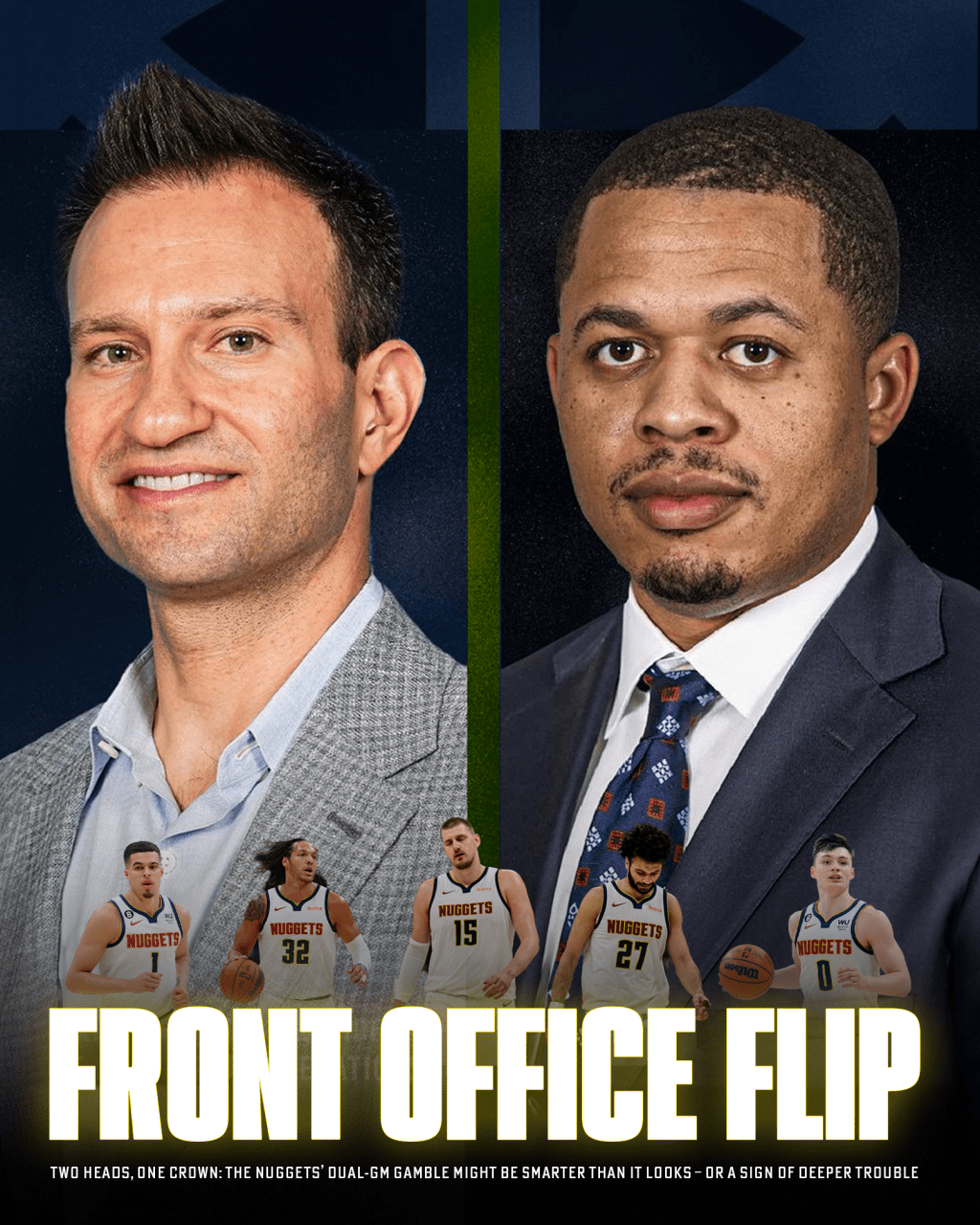
The Denver Nuggets made headlines this week — not with a blockbuster trade, a splashy free-agent signing, or even a coaching change — but with a front-office experiment that has the league talking. In a bold and decidedly unorthodox move, team governor Josh Kroenke announced the promotion of Ben Tenzer and the hiring (or re-hiring) of Jon Wallace, both assuming executive vice president roles that will effectively split the general manager responsibilities for the reigning Western Conference contender.
This setup — two voices, one front office — isn’t just unusual. It’s unprecedented at this scale. Kroenke called it “unorthodox,” but added, “everything about us is unorthodox.” That may be true — from building around a 41st overall pick in Nikola Jokić to giving first-time execs the reins in the past — but even by Denver’s standards, this is a leap of faith.
So, is this a savvy evolution in front office thinking — or a messy workaround born out of indecision and internal shakeups?
The Anatomy of the Decision
First, the facts: Tenzer, a longtime Nuggets executive with expertise in legal matters, salary cap strategy, and internal operations, has been with the organization since 2005. Wallace, who spent three seasons in Denver before a stint with the Timberwolves, returns as a high-upside talent evaluator with strong player relationships. Both men spoke about collaboration, chemistry, and the complementary nature of their skill sets. Kroenke praised their emotional intelligence and humility. “They have no ego,” he said. “They challenge each other, but come out unified.”
That may be ideal in theory — but skepticism lingers. After all, Michael Malone is gone. So is former GM Calvin Booth. And instead of replacing them in traditional fashion, the Kroenkes are doubling down on a shared power structure without a singular leader — a move that carries risk in a league where timing, decisiveness, and clarity of vision often spell the difference between contention and collapse.
Why It Could Work
There are elements here that make sense — even more than critics might admit.
For starters, Tenzer and Wallace do bring distinctly different strengths. Tenzer, a lawyer by training, is the team’s resident capologist. He’s worked his way up from intern to overseeing contracts, free agency strategy, and internal systems. Wallace, meanwhile, is more of a “basketball guy” — plugged into player development, scouting networks, and trade talks. His time in Minnesota gave him a broader lens, and his return to Denver feels intentional — both for him and the team.
There’s also precedent in Denver’s history. In the late 2000s, the Nuggets experienced relative success with a two-headed front office approach under Mark Warkentien and Rex Chapman. That duo helped build a roster that reached the Western Conference Finals in 2009, largely by balancing perspectives.
And while most franchises rely on a singular GM, a growing number of organizations have experimented with tiered VP structures or empowered multiple voices — particularly those with massive ownership groups or financial limitations tied to the new collective bargaining agreement.
Kroenke himself pointed to the realities of the second apron, saying, “We’re very conscious of that… if the wrong person gets injured, you’re quickly into a scenario I never want to contemplate — trade number 15.” That’s not just a hypothetical. It’s a sign that Denver is preparing for hard decisions — and believes that collaboration, not hierarchy, will better prepare them for the modern NBA’s constraints.
Why It Might Not
Still, as optimistic as Kroenke and company sounded, this approach raises legitimate questions.
Start with accountability. In any power-sharing model, decisions can slow down, responsibilities blur, and disagreements — even healthy ones — can stall momentum. Who makes the final call on a trade? Who’s in charge at the deadline? If a key free agent slips away or a draft move backfires, will the team know whom to hold responsible?
That ambiguity is dangerous in a league built on split-second decisions and front-office chess moves. Add to that the urgency surrounding Nikola Jokić’s prime — and his looming contract extension decision — and the stakes rise exponentially.
Then there’s the optics. Some fans wonder whether the Nuggets simply couldn’t decide between Wallace and Tenzer — or worse, whether they lacked a strong enough candidate to step in solo. Booth’s exit came without much explanation, and Malone’s departure — after leading the franchise to its first-ever NBA title — left many confused. Two hires might look collaborative, but they could just as easily signal a front office still searching for direction.
And despite the insistence on synergy, front offices aren’t startups. They’re war rooms. The GM has to own every phone call, every negotiation, every mistake. If Tenzer and Wallace can’t speak with one voice in those moments, the Nuggets risk looking uncertain — which is dangerous when agents and rival executives smell indecision.
The Jokic Factor
Let’s be blunt: this entire structure will live or die by how it supports Nikola Jokić.
At age 30, Jokić remains a generational player — but his championship window won’t stay open forever. The Nuggets know this. “We have to be conscious of the margins,” Wallace said. “We need to find some more shooting and address defensive concerns.” Tenzer added that every roster tweak must be weighed against the tax apron. Those are real concerns, and the time to address them is now.
Denver’s bench weakened last season. The Western Conference — from Minnesota to OKC — is younger, deeper, and faster. The Nuggets need to rest their stars, preserve their bodies, and rediscover the balance that fueled their title run. That starts with savvy moves around the edges — veterans, shooters, defenders — and the kind of bold decision-making that doesn’t come from a committee, but from conviction.
If Jokić delays signing an extension this summer, it won’t be because of money. It will be because he’s watching the structure above him — and asking the same question fans are: can two heads really steer one championship ship?
The Bottom Line
Denver’s front office shakeup isn’t absurd. In fact, it might even be progressive. Tenzer and Wallace appear competent, connected, and aligned in philosophy. The Kroenkes, as owners, are invested in keeping the team competitive — and claim to be unafraid of the second apron if the moment calls for it.
But make no mistake: this is a gamble. It requires cohesion, speed, and selflessness at a level rarely sustained in professional sports. If it clicks, it could set a new standard for team-building in the modern NBA. If it stumbles — especially under the weight of injuries or playoff exits — it may go down as the moment the Nuggets veered off-course.
Two heads might be better than one. Or they might pull in different directions when the franchise can least afford it.